A history of coffeeshops
10 August 2026
Not legal, not illegal. How the Dutch tolerance policy actually works, and the few addresses worth knowing.
Amsterdam's coffeeshops are one of the most misread things about the city. Nothing here is quite legal, and nothing is quite illegal either. What the Netherlands built instead was a policy of tolerance, and understanding it is most of what separates a good afternoon from an awkward one.
Tolerated, not legal
The Opium Act of 1976 drew a line most of the world did not: it separated soft drugs from hard ones. The reasoning was practical rather than permissive. If cannabis were sold in the same back rooms as heroin, everyone buying the first would meet someone selling the second, so the state pulled the two markets apart and kept the softer one in daylight where it could be watched.
What followed is gedoogbeleid, the tolerance policy. Selling cannabis remains an offence on paper; the prosecutor undertakes not to bring it, so long as a shop keeps to the rules. That is the whole architecture. Nothing was legalised. The law looks away, deliberately and in writing.
The rules are strict and worth knowing before you walk in. Licensed premises only. Eighteen and over, with photo ID. No more than five grams per person per day. No alcohol on the premises, which is why a coffeeshop is never also a bar. No advertising, which is why the good ones are quiet fronts rather than neon. And it is meant to be used there or somewhere private, not in the street.
The back door
At the centre of it sits a contradiction the Dutch have argued over for fifty years. A shop may sell across the counter, but nobody may legally supply it. The front door is tolerated and the back door is not, so every licensed shop is stocked through a chain the same law still treats as criminal. It has a name here, the achterdeurprobleem, and it is why a controlled, legal supply chain is being trialled. Ten municipalities are taking part, among them Breda, Tilburg, Arnhem and Maastricht. Amsterdam is not one of them, so nothing you buy here comes through it.
Where to go
The city has hundreds and the difference between them is enormous. The ones worth an hour are calm, well run, and staffed by people who will talk you through a menu without smirking.
- Boerejongens, the closest Amsterdam comes to a proper house. Staff in white coats, served across a counter like a good delicatessen, and a menu that is curated rather than exhaustive.
- Tweede Kamer, a small wood-panelled room near the Spui, trading since 1985 and long thought one of the more civilised in the centre. Quiet, and easy to walk past.
- Dampkring, also near the Spui on Handboogstraat, going since 1993 and the most theatrical interior in the city: carved wood, mosaic and coloured glass, closer to a Jules Verne set than a shop. Its walls carry the framed photographs of everyone who has passed through, which is a long list. The scene in Ocean's Twelve where Clooney, Pitt and Damon talk business was filmed here, and the shop has trafficked on it ever since without letting the room get worse.
- Green House Centrum, on Oudezijds Voorburgwal in the middle of De Wallen, in a seventeenth-century canal house. Open since 1992 and the most decorated shop in the city: the counter at the back is lined with Cannabis Cup trophies, and the seed company behind it is why half the strains on other menus exist at all. The walls are its Hall of Fame, which is a formal thing here rather than a turn of phrase: some two hundred framed visitors, Eminem and Rihanna and Kate Moss and Tarantino and Mike Tyson among them. The address is the red-light district, but the room itself is a canal house with a terrace on the water, not a spectacle.
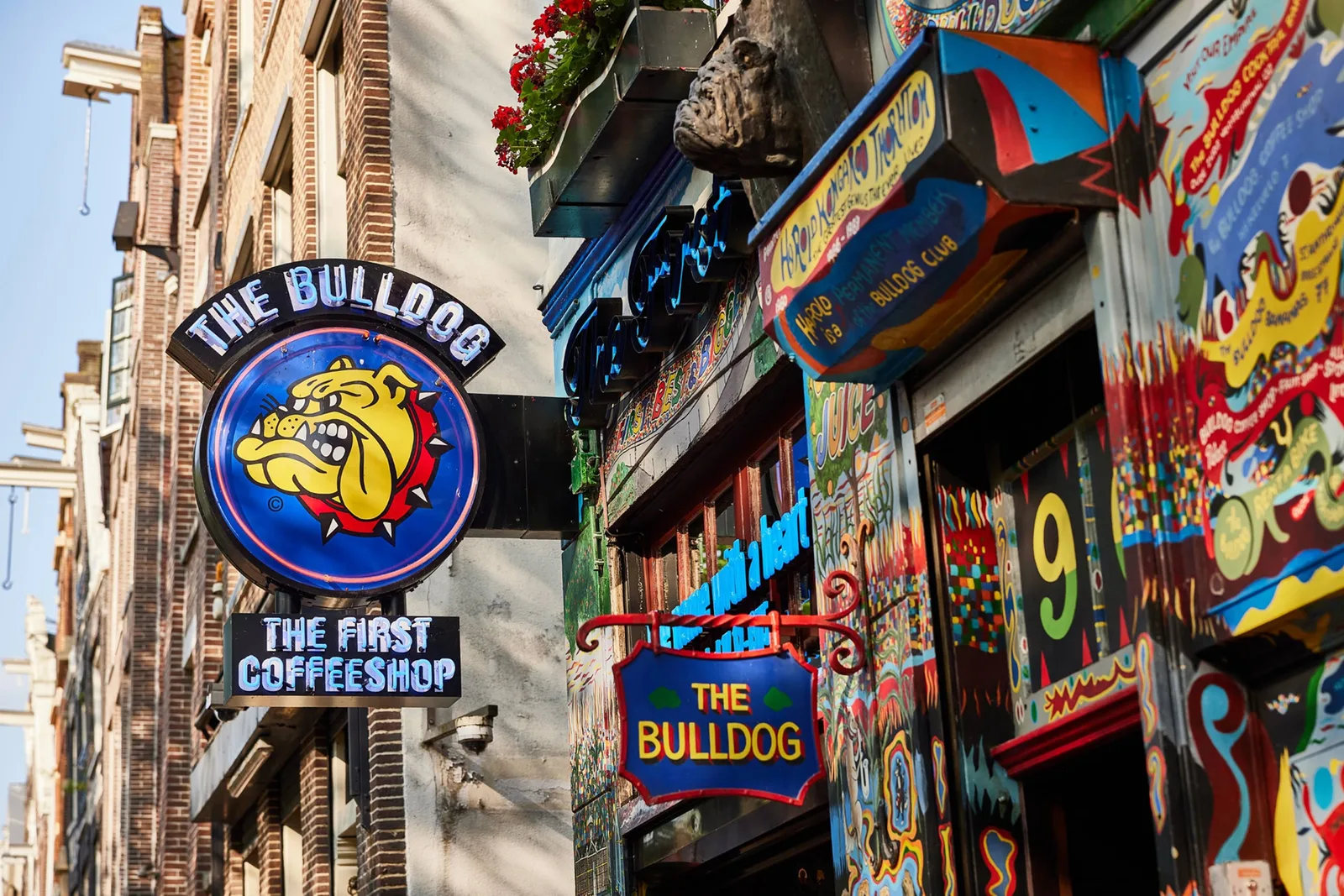
- The Bulldog, the oldest name in the business, open since 1975 and now a small chain. Worth knowing precisely because it is the famous one: it is where the city's tour groups end up, and going in with that expectation is better than wandering in expecting the quiet of Tweede Kamer.
- Tha Dogg House, the Snoop Dogg-branded shop that opened in 2024, done out as a West Coast set down to the gold toilet seats, which is either the joke or the point depending on the afternoon. It is also a small lesson in the rules above: it opened as SWED, for Smoke Weed Every Day, and Amsterdam ruled the name was itself cannabis advertising and therefore not allowed. It is Tha Dogg House now.
If it is your first time
Say so. Staff are used to it, and it is the single most useful thing you can tell them. Edibles are the usual mistake: they take an hour or more to arrive, and waiting impatiently does not speed that up. Start smaller than you think, do not put it on top of an evening's drinking, and give yourself somewhere to sit.
How to get there
None of these are in De Pijp, so all of them are a journey. The Spui pair, Tweede Kamer and Dampkring, sit a few streets from each other: metro 52 from De Pijp to Rokin, two stops, then five minutes on foot. Green House is the same metro ride and about eight minutes east from Rokin, over the canals into De Wallen. It also keeps a branch in De Pijp, a few minutes from here, with a Hall of Fame of its own if you would rather not cross town for it. The Bulldog has branches all over the centre, the Leidseplein one being the easiest to find. Boerejongens and Tha Dogg House are both west, fifteen to twenty minutes by bike, or tram from Ceintuurbaan.
The honest version: it is a regulated shop, not a spectacle. Treat it the way you would a good wine merchant, ask what they would recommend, and it is an unremarkable hour of the afternoon.